The Clubhouse
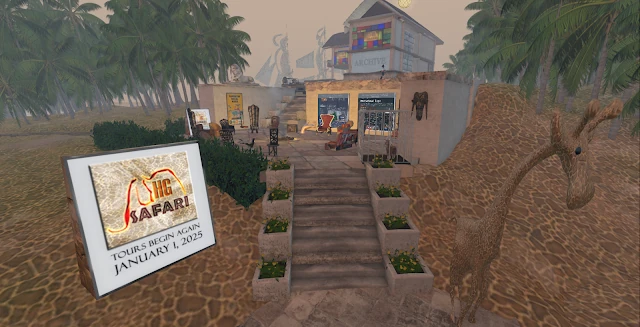
HG Safari tours in Opensim start on this region at the Clubhouse. Travelers meet here and collect the Landmarks and any last minute info about that week's trip. These tours give everyone a chance to meet the builders and owners of the regions we visit, to make new friends, and learn what's going on in places all over Opensim - the 'hyperverse'.
Since 2014, there have been more than 400 HG Safari events, we have visited hundreds of regions on dozens of grids, large and small.
Safari tours are on Wednesdays. The trips last 2 hours, from 12 noon to 2pm Pacific Time (SLT). We go to two different destinations each week, staying about an hour at each destination. There are 3 seasons of HG Safari each year, beginning in January, April, and September. Each season lasts ten weeks.
We meet at the Clubhouse before the event begins so that new people have the chance to meet Safari regulars, who can help them if they get lost. Meeting at the Clubhouse also permits us to know just how many people are going on the tour, which helps us to keep the group together. For more information on how the tours are organized, and how you can request a visit from the Safari, click on this link.
The HG Safari tours are documented on the HG Safari blog, so if you were not able to join us on the tour, you can read about our travels, and about other interesting places on the hypergrid, and learn something of the history of the Opensim community.
To read more about the Safari Clubhouse, visit this page.
HIE - the stage
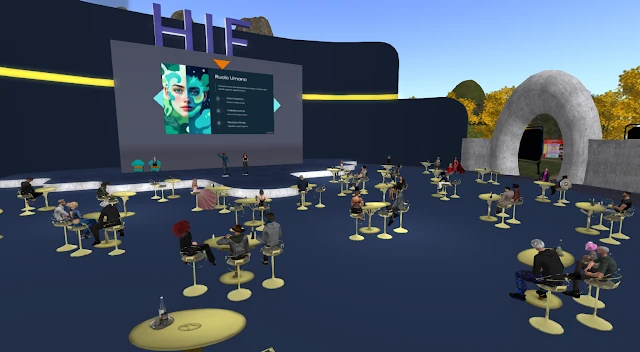
Called 'HIE' for short, the annual Hypergrid International Expo is held on a dedicated 3x3 VAR region with a custom landscape and auditorium.
HIE combines two elements. The 'Exposition' is like a fairground, and features publicity booths by Opensim residents of all kinds. This Expo has gifts, Landmarks, and information about people, projects and places all over Opensim. During the season, the Expo park contains well over 100 booths with something for everyone, and remains open for several months.
HIE is also a live, two day conference where people give talks on the subject of projects, technical developments, and personal experiences of the community of Opensim. It is similar to the Opensim Community Conference (OSCC), but at HIE the speakers give talks in their native languages: German, French, Italian, Spanish or Portuguese. The event also features dramatic art presentations. Music sessions open and close the event. To know more about past events and to stay informed about the next HIE, see our website.
To read more about the HIE expo region, visit this page.
Cornflakes Tribute
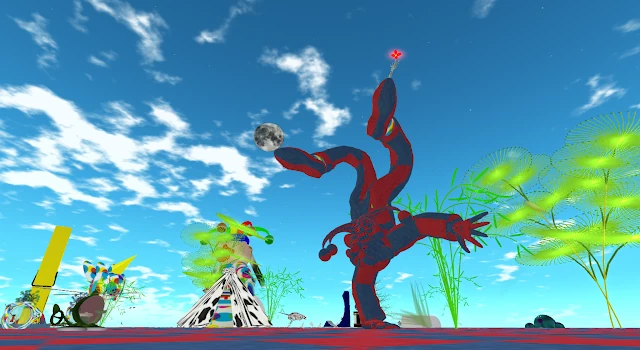
Cornflakes Tribute is the original region by Cornflakes Woodcock, an early resident of OSGrid who made prim objects that were silly, funny, and ingenious. Shortly before he died back in 2013, Cornflakes gave the region to his good friend Wordfromthe Wise. For a long time, Cornflake's friends in Opensim were not aware that he had passed away. This is something that often happens in Opensim, where the connection between virtual acquaintances people is often tenuous.
Since 2015, Cornflakes Week is celebrated during the final 7 days of February each year. It's a uniquely Opensim event, not connected with any real world national or religious festival. Any grid can celebrate in any form they like; many choose to use primmy objects and primary colors. The event is often an occasion to remember those friends who have passed away, or are otherwise unable to come inworld any more.
Since Worldfromthe Wise is no longer active in Opensim, he donated the .oar to Thirza Ember, and now the original Cornflakes Tribute region is an addition to HG Safari grid, as a reminder of the heritage and history of this virtual platform.
To read more about Cornflakes Tribute region, visit this page.

Inworld Review logo
Inworld Review is a talk show on YouTube. It was created and presented by Mal Burns for over a decade, on various platforms in virtual worlds. Each week on Sundays at 12 noon Pacific Time, Mal Burns and his cohosts interviewed dozens of people active in virtual worlds, and brought news items about technical innovation, opinions and ideas, and videos of fascinating places to explore, uniting the community in a unique way.
Since 2022 Inworld Review has been focused primarily on Opensim, and has had studios on a number of different grids, including Kitely, OSCC, OSGrid, Avacon, Neverworld, and more, making it a truly Hypergrid friendly program.
Mal Burns youtube channel is here.
Mal Burns died in 2025, but the show he started continues with a new studio and format. The new base of Inworld Review is located on HIE region, since Mal Burns was co-creator and a vital part of the team that organizes the Hypergrid International Expo each year.
Links to Mal Burns Memorial special event and video.
Inwold Review has a new youtube channel here.
To read more about Inworld Review, visit this page.
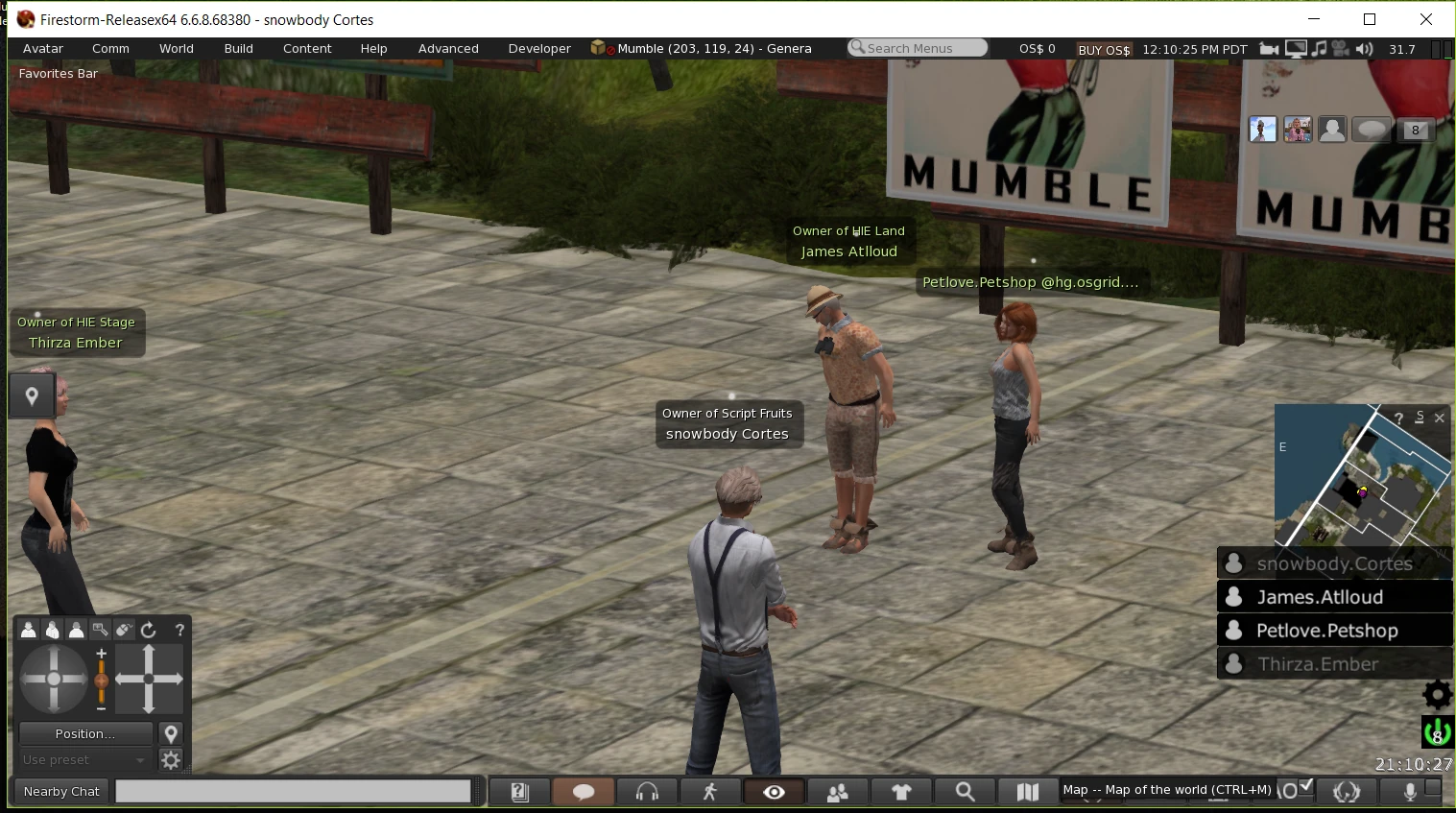
First MumbleVoice tests in 2024
The Mumble region on HG Safari grid is home to a project called the HG MumbleVoice integration in OpenSimulator project. Development began in January 2024.
Over the years, many different independent development projects have investigated ways to integrate Mumble with OpenSimulator.
The MumbleVoice optional module for OpenSimulator has been developed to experiment an alternative voice system that could be grid-hosted and could potentially substitute Vivox in the future. Other solutions also exist.
HG MumbleVoice can be used by itself for basic voice functionalities (i.e. voice in parcels, conference voice calls). It can be activated in-world by navigating to the link privately sent to your avatar or by visiting this page. In both cases, your avatar must be already logged in and located on a region that has HG MumbleVoice functionalities (e.g. Mumble region).
Bianconiglio will offer advanced functionalities for HG MumbleVoice, for example you will have lip movement, 3D spacial voice, special features for voice events, your profile picture and details, and other audio effects.
Group voice is not supported.
You can find documentation about the HG MumbleVoice history and developments here.
To read more about Mumble region, visit this page.
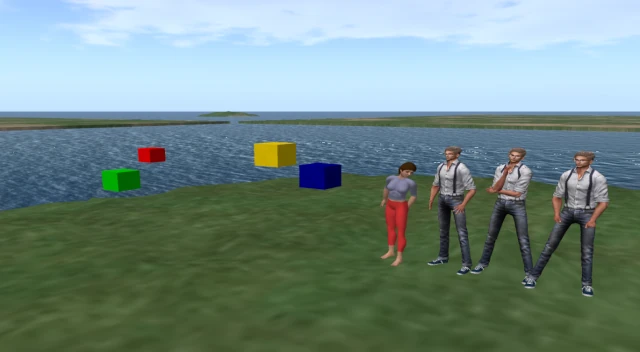
Room of Requirements (RoR) tests in 2025
Bianconiglio is a set of tools for OpenSimulator. One of the things it does is to augment the features of the basic HG MumbleVoice as a service for Opensim. The name 'Bianconiglio' means White Rabbit in Italian.
Mumble region runs the latest stable version of Bianconiglio and HG MumbleVoice as optional modules for OpenSimulator.
The Bianconiglio project started in May 2024. It came about in response to the desire of creators to mantain immersivity when building and to modify assets after they have been imported in world.
At present, once a thing has been imported, it typically can no longer be modified.
Bianconiglio tools support residents who want to create, experiment, and build inworld via a non-intrusive eye shaped HUD. Bianconiglio is a sort of co-Viewer, to enhance the experience of making and modifying things in virtual worlds.
Bianconiglio is still a work in progress. New tools will be added, existing tools will be improved.
Bianconiglio developments are documented
here.
To read more about Mumble region, visit this page.
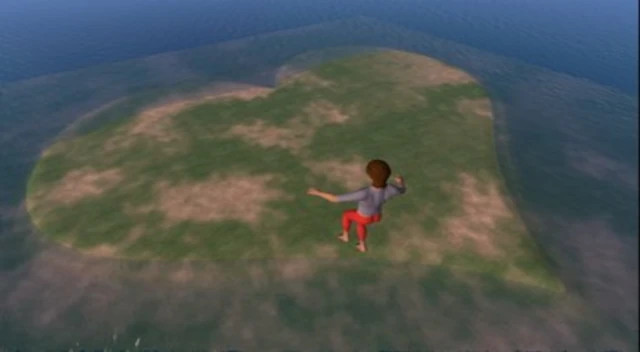
An heart shaped terraformed sim
OpenSimulator is a free platform that allows anyone to create regions and grids that can be visited in hypergriding by a Viewer, and none of the regions or projects mentioned on this page would be possible without it.
It creates an environment very similar to Second Life (SL) but it has unique features, for example variable size regions, NPCs (Non-Player Characters) and it supports a subset of the Linden labs Script Language (LSL) extending it with innovative functionalities in OpenSimulator Script Language (OSSL). Nowadays, the YEngine has replaced the previous XEngine to run the OSSL scripts. Update: Second Life is now experimenting with a new SLua script language (a Lua language variant), in beta testing in SLua Beta Regions on the main grid. It looks very interesting because it mantains full compatibility with LSL, it requires less resources (CPU and memory), and it offers new capabilities. We'll see how this will influence OpenSimulator in future.
OpenSimulator code is written in C# language. It can run on Windows, Linux and Mac platforms with the support of the Microsoft framework (the Mono framework is no longer compatible). The binary (and source) distributions of OpenSimulator official releases are available here.
It interfaces with several Databases, from the simple Sqlite, to the more complex MySQL and MariaDB.
Volunteers mantain the OpenSimulator source code improving and fixing it on a Git repository and github mirror. Issues are reported and tracked on Mantis here.
Hundreds, perhaps even thousands, of independently owned and operated grids are running OpenSimulator.
OSGrid,
Neverworld Grid,
Wolf Territories Grid,
Alternate MetaVerse (AMV),
Craft-World,
Pangea Grid,
Kitely,
Zeta Worlds,
Avi World,
Littlefield Grid,
to name just a few of the larger grids. A Wikipedia page also exists. A number of OpenSimulator source-code forks exist.
You need a Viewer to enter any of these OpenSimulator worlds.
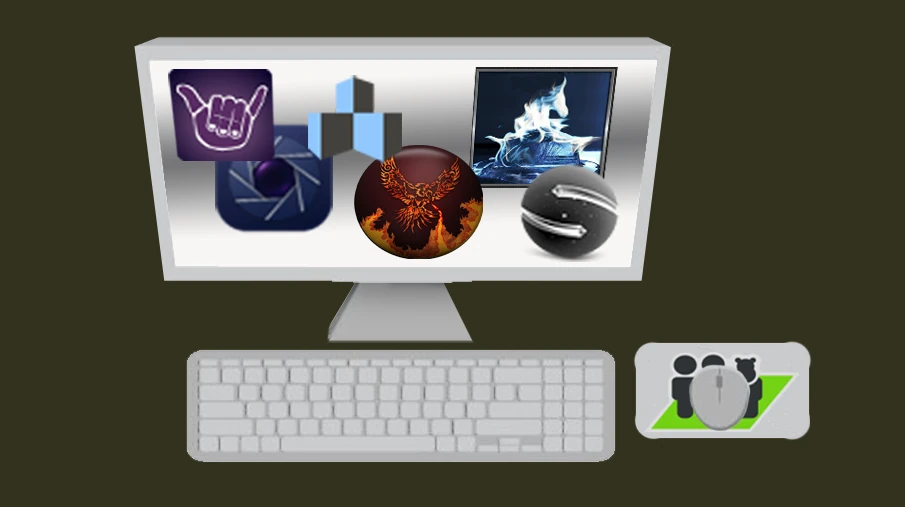
Some Viewers
If OpenSimulator is the mother of virtual worlds, the Viewer is for sure the father. The viewer is what creates the 3D virtual world immersivity.
Not only did LindenLabs create both the mother (simulator) and the father (viewer), they defined the communication protocols that make viewer and simulator interact with each other in real time. Allocating the correct portion of each functionality on the simulator and on the viewer created the wonderful virtual world that Second Life is.
LindenLabs kindly made the viewer's C++ source code available in the public domain and by doing so, they opened up the possibility to create new viewers, the so called Third Party Viewers.
OpenSimulator came about as the result of an experiment to re-create a compatible and open source virtual world.
With time, OpenSimulator and Second Life evolved more and more and the teams that were mantaining those Third Party Viewers had to support both Second Life (Policy on Third Party Viewers) and OpenSimulator with specific viewer versions (or branches).
Firestorm Viewer,
Cool VL Viewer,
to name just two of the main and active viewers for OpenSimulator.
The Hypergrid concept has been implemented into viewers that support OpenSimulator.
As OpenSimulator evolved, many people set up their own grids.
The hypergrid concept is what allows the creation of completely separate OpenSimulator grids that have their own assets and population and can be visited by any avatar with a Viewer. By doing so, OpenSimulator has completely transformed the vision of a monolitic single virtual world.
Second Life is very large but it is a single grid. A Beta Grid exists but there is no travel between the two.
An experiment to teleport (or hypergrid) from Second Life to a grid in OpenSimulator was documented in 2008 by Torley Linden on youtube.
Since then, much progress has been made in OpenSimulator and now when you travel on the hypergrid, you can access a part of your inventory (MySuitcase). In the case of OSGrid, your entire inventory is accessible.
"Hypergridding" is now a common expression in OpenSimulator to describe the action of visititing a grid other than your own.
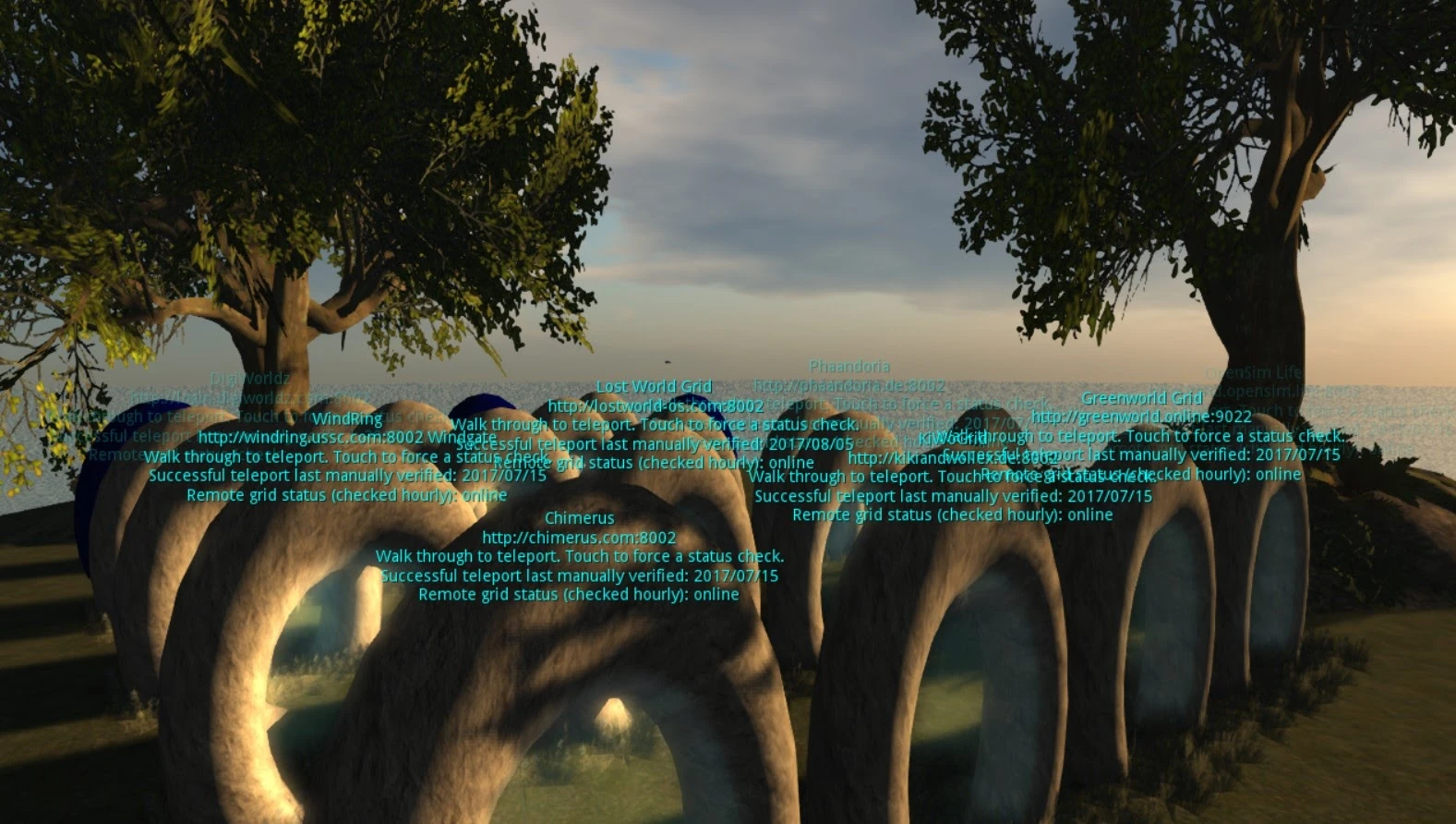
Hypergates on Santuary Grid in 2017
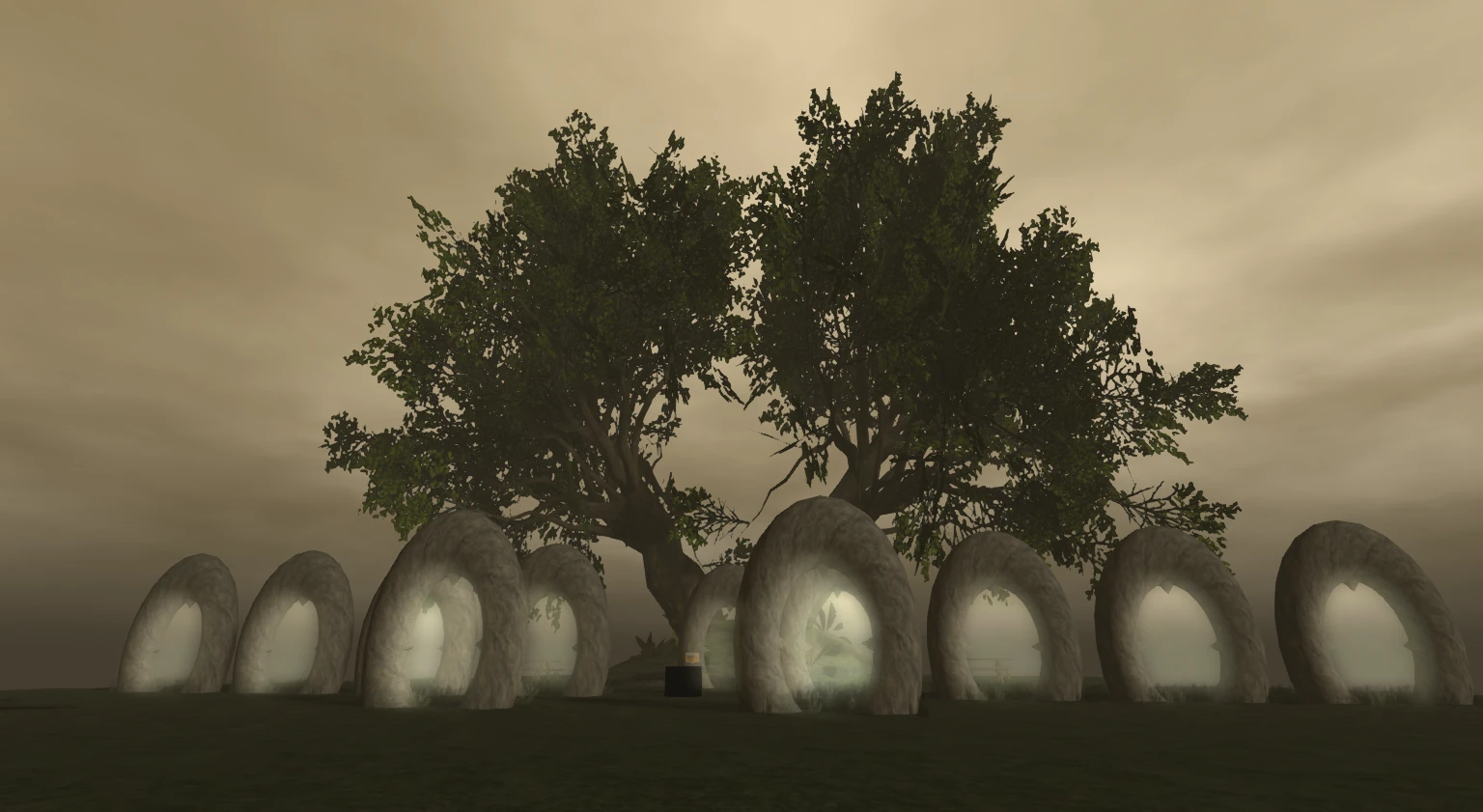
Hypergates on Santuary Grid in 2017

Social media
One of the greatest challenges and biggest complains of people trying to navigate Opensim, especially if they are coming from Second Life, is the lack of a centralized information system. This can be disorientating and discouraging, but for many in Opensim this is considered a feature, not a bug.
These worlds are totally independent and so each one has its own way of doing things. This makes it impossible for the viewer to offer any kind of universally accepted information system, beyond the basics - friends list, groups, landmarks and things of this nature. This is why most people use some form of external communication, some sort of social media, although again, no everybody agrees on which external form of communication is the best.
The longest running and most popular form of social media specifically aimed at OpenSimulator residents is OpenSimWorld. As the name implies, it is the most complete directory of Opensim worlds connected through the hypergrid. It provides an easy way to discover amazing virtual worlds and to advertise your own region. Popular regions are shown here.
The HG Safari Clubhouse, the Hypergrid International Expo (HIE), and the Mumble regions are registered on OpenSimWorld.
By a simple search on the website, you can find interesting stuff. For example free items or clothes. Once you know where to go, it is simplicity itself to go "hypergridding" to the stores!
Most grids have some form of social media, many use Facebook and Discord to make announcements and send invitation to parties. Discord also has servers where technical details are discussed. If you do not like mainstream social media, you can find some of Opensim residents on Mastodon, TeamSpeak, and you may want to join other smaller Opensim related websites such as OpenSim Social Network and Hype Metaverse. This is not an exhaustive list, websites come and go.
Another interesting website is HyperCat. It is a 'listing service' that collects the names, and the pictures of items on the HyperGrid. It only lists items that are ForSale or set as TakeCopy.